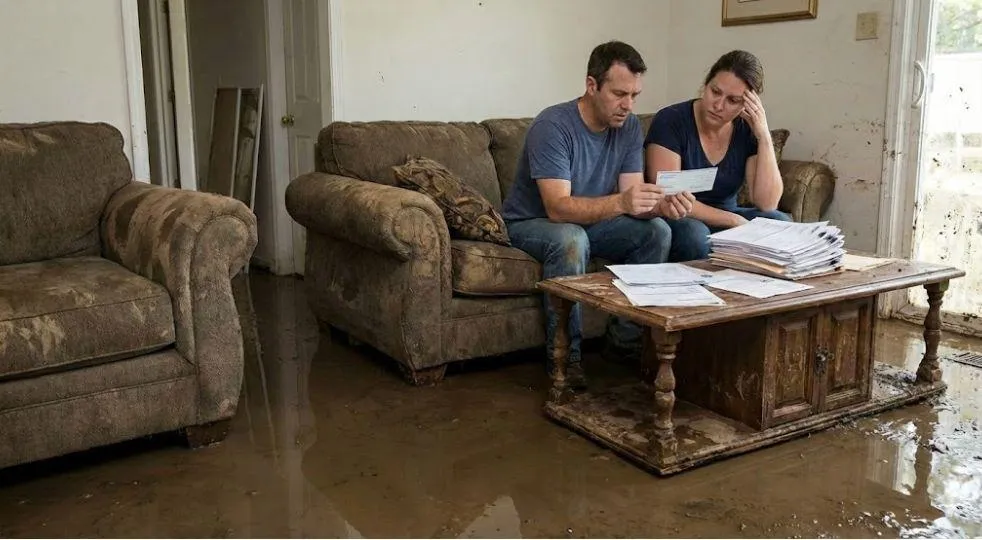
Flood Insurance Doesn’t Guarantee a Full Financial Recovery
Insurance pays by coverage rules — not total repair or recovery cost.
Flood Insurance Doesn’t Guarantee a Full Financial Recovery
Most commercial building owners assume flood insurance functions like a financial safety net.
If a flood happens, insurance pays, and the property is made whole.
That assumption is understandable — and it’s also where financial risk quietly begins.
Flood insurance is often mistaken for a recovery guarantee. In reality, it is a payment system governed by rules, limits, and definitions that rarely align with the full cost of getting a building back to normal operations.
Flood insurance does not pay based on what it costs to recover a property.

It pays based on what the policy defines as covered damage, priced according to insurance logic, scope rules, and reimbursement limits.
Insurance produces an estimate using:
Defined categories of covered damage
Approved scopes of work
Pricing frameworks tied to policy rules
Contractors, on the other hand, price based on:
Actual work required
Site conditions
Expanded or preventative scope
Operational urgency
These two pricing systems are not designed to match.
Insurance is not attempting to reimburse “whatever was spent.”
It is paying for specific eligible damage, priced its way.
The owner sits in the middle — often assuming those numbers should align.
When recovery costs exceed what the policy recognizes as eligible, the difference does not disappear.
It lands on the owner’s balance sheet.
This is why flood losses often feel confusing or unfair:
Insurance did pay
Contractors did perform necessary work
Yet unreimbursed costs still remain
The financial loss isn’t caused by a denial or a dispute.
It’s caused by an expectation gap — assuming flood insurance was designed to fund full recovery.
It wasn’t.
This misunderstanding often surfaces after work has already started and invoices are in hand.
By then, the financial exposure is already embedded in the recovery process.
Flood is a financial risk, not just an insurance event.
Flood insurance is a tool — not a guarantee of full financial recovery.
The difference between the two is clarity. Insurance is a tool. Clarity is protection.